Best for: Avoid: zone instead
How Much Does Gym Flooring Cost?
Honestly: less than the slab repair you get from under-specifying, and more than the foam tiles you saw online. Here is what actually drives the number, so you can budget a project properly instead of guessing.
3 drivers
Thickness, format, subfloor
Subfloor
The most common overrun
Zoned
How to cut cost safely
Free
Specification review
What drives the cost of gym flooring?
Three things drive gym flooring cost: the thickness you need, the format you choose, and the condition of the subfloor underneath. Of the three, subfloor condition is the one that most often moves a budget after work has started, because moisture, flatness and old adhesive are invisible until the slab is tested and exposed.
The most common delay we see is a specification that names a product without stating performance criteria. If you send us a draft before it is issued, we will flag anything that will limit your responses or inflate your pricing.
Cost Drivers
Relative cost by material and format
Ranked from most economical to premium. Actual figures depend on your site, so we price per project.
| Surface | Relative Cost | Notes |
|---|---|---|
| Rolled rubber | Lowest | Best value per square foot for large open areas. |
| Interlocking mats | Low | No adhesive cost; higher material cost per foot than rolls. |
| Glued modular tiles | Moderate | Material plus adhesive and labour; handles complex layouts. |
| Fitness carpet | Moderate | Comparable to tile; specified for cardio and quiet zones. |
| Gym turf | Moderate–High | Underlayment, if needed, is a significant part of the cost. |
| Sprung studio hardwood | High | Engineered resilient assembly beneath the surface. |
| Seamless poured rubber | Premium | Labour-intensive, fully custom, zero seams. |
| Maple court assembly | Premium | Subfloor system, sanding, game lines and finish. |
Want a real figure instead of a ranking? Send us your dimensions and zones.
Group exercise flooring formats
Three ways the surface meets the slab, chosen by budget, ceiling height and how permanent the studio is.
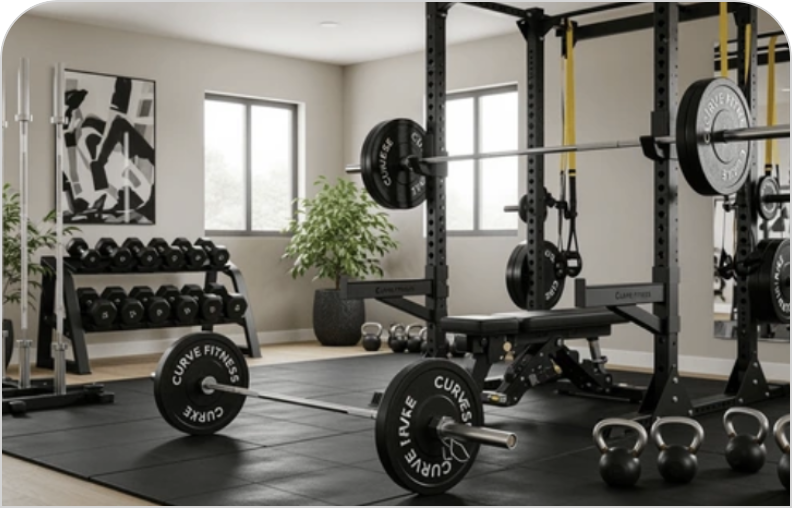
Over-specifying Uniformly
Specifying 3/4″ rubber across an entire facility because the weight room needs it. You pay premium rates to floor the yoga room and the cardio deck.
- Zone the floor before pricing it
- Step down thickness away from platforms
- Often the single biggest available saving
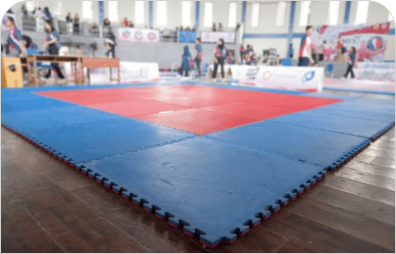
Under-specifying Platforms
Saving money by putting 1/2″ where loaded bars are dropped. The slab cracks and spalls, and the repair costs multiples of the flooring.
Hardwood with a bonded resilient backing. Lower build height than a clip system, quicker to install, less cushion at the top end.
- Never under-spec a drop zone
- Slab repair dwarfs flooring cost
- Also the most common noise complaint
Best for: Avoid: spec to the drop load
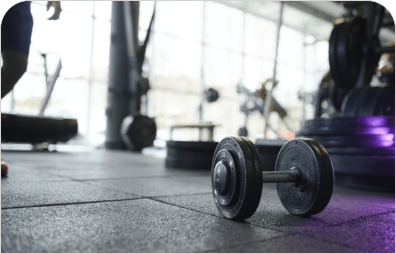
Skipping Subfloor Testing
Quoting and ordering before the slab is moisture-tested. The floor goes down, the adhesive fails, and the whole installation is lifted and redone.
Sheet vinyl on a foam or rubber underlay for barefoot and mat-based classes, or where a wipe-clean surface matters most.
- Test before quoting, not after
- The number one cause of failure
- Turns one project into two
Best for: Avoid: test the slab first
How to budget a flooring project properly
Follow this order and your final invoice will look like your first estimate.
Zone the space on paper first
Mark where weights drop, machines sit, classes run and members walk. Thickness follows the zones, and zoning is where the savings are.
Get the slab tested before pricing
Moisture and flatness results determine whether you need mitigation and levelling. These are real line items, not contingencies.
Price material and installation separately
Understand what is material and what is labour and prep. It tells you whether supplying only and using your own installer actually saves anything.
Budget for old floor removal
Removal and disposal, particularly of old adhesive in older buildings, occasionally costs more than the new floor. Find out early.
Plan phasing against your access
Staying open means zone-by-zone or overnight work, which changes the labour model. Decide this before the schedule is set.
Where The Value Is
What you are actually buying
Slab Protection
The floor is a consumable layer protecting a structural one. That is the whole economic case for specifying properly.
Twenty Year Horizon
Commercial rubber amortised over 15 to 20 years costs less annually than replacing a cheap floor three times.
Noise Compliance
For multi-tenant buildings, adequate thickness is what keeps you compliant with your lease and your neighbours.
Liability Reduction
Slip resistance and shock absorption are risk-management line items, not just comfort features.
Free Specification
We mark up your plan zone by zone before pricing, at no charge, so the quote matches the building you have.
One Accountable Party
Specification, supply, installation and warranty from one supplier rather than three parties pointing at each other.
Cost FAQ
Questions about gym flooring cost
How much does gym flooring cost per square foot?
Rolled rubber is the lowest cost per square foot, modular rubber tiles sit above it, and seamless poured systems and hardwood court assemblies are the premium end. Because subfloor condition and thickness change the figure so much, we price per project rather than publishing a single rate.
What makes gym flooring more expensive than expected?
Almost always the subfloor. Moisture mitigation, grinding and levelling, and removing old adhesive are the line items that surprise people, and none of them are visible until the slab is tested and exposed. Testing before quoting is what removes the surprise.
Is thicker gym flooring always more expensive?
Per square foot, yes. Across a project, not necessarily. Specifying heavy rubber everywhere costs far more than zoning it properly, and under-specifying the platform area to save money can cost you a slab repair that dwarfs the original flooring budget.
Is it cheaper to install gym flooring yourself?
On material cost, yes, and we supply material only for exactly that reason. But the most expensive failures we are called to fix are DIY installations over untested slabs, where the floor has to be lifted and replaced. Prep is where professional installation earns its money.
How much does it cost to refinish a hardwood court instead of replacing it?
Refinishing costs a fraction of replacement and is usually the right call if the maple still has wear layer left and there is no moisture damage or structural cupping. Sand, repaint game lines and recoat. We will tell you honestly which one your floor needs.
Do you offer financing or phased billing?
Large facility projects are commonly phased, which lets the work and the billing span budget periods. For schools, municipalities and non-profits we can also work within bid cycles, purchasing co-operatives and grant timelines. Ask when you request a quote.
Get a real number for your project
Ranges only get you so far. Send us dimensions, zones and a photo of the existing floor and we will come back with an actual installed price.
- Free specification review
- Supply-only or installed
- Nationwide coverage